In March 2026, Raiders owner Mark Davis paid $38.75 million for four adjacent homesites in Ascaya, the guard-gated hillside community carved into the McCullough Range above Henderson. The lots span roughly 19.2 acres, though aerial surveys show only about 7.6 of those acres are actually buildable once the mountainside terrain is accounted for. Ascaya's development team told the Las Vegas Review-Journal, which reported the deal in April 2026, that it was the largest homesite purchase ever recorded in the Las Vegas area. The same outlet reported that Davis, who already built a roughly 15,000 square foot mansion down the mountain in 2024, described the new parcel in a text message as "the crown jewel of Ascaya."
That deal happened inside a community where, by the numbers, almost nothing sells quickly. Recent closed-sales analyses put Ascaya's median days on market for completed homes somewhere between 165 and just under 200 days through Q1 2026, depending on which data set you pull. Compare that to a Henderson valley-floor resale median of 38 to 45 days over the same stretch, and you have a neighborhood that appears to move at roughly a quarter of the speed of the rest of the city it sits above.
If you are shopping Henderson's luxury tier and you saw those two numbers side by side, you might read them as a warning. A slow market usually means soft demand or stubborn pricing. In Ascaya, it means neither. It means the transaction you are looking at was never structured to move fast in the first place.
The Math That Looks Like a Warning
Start with what the days on market figure is actually counting. In most neighborhoods, a long time on market signals a listing that buyers are passing over. In Ascaya, a meaningful share of that clock is running on homes that are not finished yet, homesites still working through design review, and completed estates so specific to one buyer's taste that the pool of people who want that exact house at that exact elevation is small by design.
The community caps out at 313 lots. There is no phase two. The McCullough Range topography and the view-corridor easements recorded against every parcel mean the footprint cannot expand, so the entire supply of Ascaya real estate that will ever exist already exists on paper. As of April 2026, the development team reported 92 completed homes, 31 more under construction, and 32 additional lots working through architectural review, a build-out status confirmed in the same Review-Journal report that covered the Davis purchase. A separate brokerage analysis of Q1 2026 activity put the number of lots still available for outright purchase at roughly 64. Both figures can be true at once. Plenty of Ascaya land is already spoken for by owners who have not broken ground, which is exactly the kind of holding pattern a 313-lot ceiling produces.
How Design Review Shapes the Build Timeline
Ascaya's architectural review committee is one of the strictest in the region, and its requirements shape the timeline. Traditional or Mediterranean-influenced designs are typically rejected on first submission and sent back for revision, according to a 2026 buyer's guide from a Henderson custom-build firm. The committee enforces a single desert-contemporary vocabulary across the entire mountain, without exceptions for a buyer who prefers a different style.
Once a design clears review, the clock keeps running. Custom builds in Ascaya typically take 18 to 36 months for construction after the pre-construction period. City of Henderson permitting adds another 90 to 150 days after architectural approval before a building permit is even issued, and every submission requires a geotechnical report dated within the past year, because hillside grading and retaining wall design vary lot by lot. Total pre-construction time of six to nine months is considered normal before a shovel goes in the ground.
None of this shows up in a listing photo. It shows up in the days-on-market column, because a transaction that includes a multi-year build is never going to close on the same timeline as a move-in-ready resale three miles down the hill.
Two Henderson Enclaves, Two Different Bets
| Ascaya | MacDonald Highlands | |
|---|---|---|
| Total lots | 313, hard cap | Roughly 1,200 acres platted since 1998 |
| Buildable inventory (early 2026) | Roughly 64 lots available for purchase, 32 more in review | Fewer than 30 buildable parcels remain |
| HOA dues (2026) | About $605 a month | About $300 a month, plus $100,000-plus initiation and $1,200-plus monthly for DragonRidge golf members |
| Typical build cost | About $1,650 per square foot | About $1,200 per square foot |
| Design review posture | Desert-contemporary design focus; traditional styles are typically returned for revision | Broader "Desert Elegance" latitude across several architectural styles |
| Resale pace | Months, often five to six-plus | Weeks to a few months for turnkey inventory |
MacDonald Highlands, the older and larger of the two hillside communities, is not slow in the same way. It carries its own strict review process and its own hillside engineering requirements, but its resale supply includes finished, move-in-ready estates every week, because it was never a purely custom-only enclave. That flexibility shows up in the record book too. The $25.25 million sale of 685 Dragon Peak Drive in July 2025, a 12,655 square foot Blue Heron-built estate sold by LoanDepot founder Anthony Hsieh, still stands as the highest residential sale price in Las Vegas Valley history. It closed in a community where a buyer can, in theory, tour a finished house on Monday and write an offer by Friday.
What the Friction Actually Buys
Here is what buyers may value in Ascaya's slower process. Price per square foot on completed Ascaya homes has compounded at roughly 6.5 percent a year from 2020 through Q1 2026, outpacing the broader Henderson luxury resale market's roughly 4.8 percent pace over the same period. The median completed sale in the community's mid-tier is running near $7.5 million for a 6,500 to 8,000 square foot contemporary estate as of the most recent 2026 data.
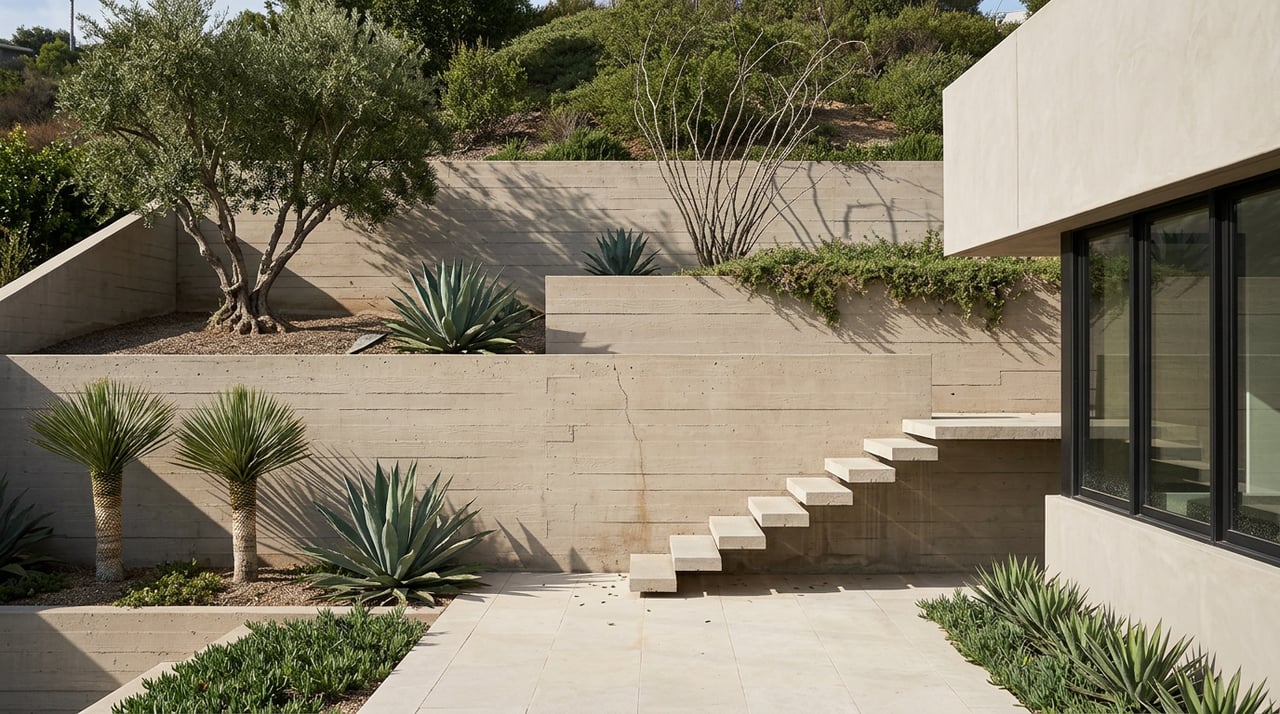
The mechanism behind that gap is the same friction that frustrates an impatient buyer. A hard lot cap means no future phase can dilute anyone's view. Recorded view-corridor easements mean a neighbor's future build cannot block what you paid for. And a design review board that enforces a single architectural vocabulary means the built environment gets more visually coherent with every home that finishes, rather than more crowded or mismatched. Building here required moving roughly 15 million cubic yards of material through the McCullough Range and constructing 31 miles of rock retaining walls averaging 12 feet tall. That is not marketing language. It is the reason the mountain can support 313 estates at all.
Who the Slow Market Actually Serves
If your timeline runs on a normal relocation schedule, meaning you need a house you can walk into within a few months, Ascaya's pipeline will frustrate you no matter how much you love the views. MacDonald Highlands, with its faster-moving turnkey resale supply and its own tightening inventory of fewer than 30 remaining buildable parcels, is the better fit for that kind of timeline, and it still delivers the kind of trophy sale that makes headlines.
If you are building toward a compound you intend to hold for decades, the 18 to 36 month build cycle and the strict design review are not obstacles standing between you and the house. They are the reason the house you eventually finish will still be worth building in twenty years. A market that cannot move fast because supply cannot expand is a very different thing from a market nobody wants to buy into.
Either way, the days-on-market number by itself tells you almost nothing about whether a Henderson hillside community is worth your attention. It tells you how the supply is structured. What you do with that information depends entirely on your own timeline, and that is a conversation worth having before you fall for a lot at sunset.
Common Questions
How many homesites are actually left in Ascaya? As of early 2026, roughly 64 lots remained available for outright purchase, while another 32 were already in architectural review and 31 were under active construction, according to the community's development team and separate brokerage reporting.
Is Ascaya's HOA more expensive than MacDonald Highlands? Yes. Ascaya's 2026 assessment runs about $605 a month, compared to roughly $300 a month in MacDonald Highlands. MacDonald Highlands owners who join DragonRidge Country Club pay a separate golf membership on top of that, often $100,000 or more to initiate plus $1,200 or more monthly.
If I buy a lot in Ascaya today, how long until I could move in? Plan on 18 to 36 months for construction, plus 6 to 9 months of pre-construction time for permitting and geotechnical work. A buyer who wants to move in within a year should look at completed resale inventory rather than a raw lot.
Choosing between Ascaya's scarcity and MacDonald Highlands' faster-moving inventory is not a decision you should make from a listing photo. If you want a straight read on which hillside community actually fits your timeline, budget, and long-term plans, Michael Boyle can walk you through the current lot availability, build costs, and resale comps on both sides of the McCullough Range. Schedule a free consultation or request an instant home valuation to see where you stand.
This article is general information, not legal, tax or financial advice. Consult a qualified professional about your situation.